
Introduction
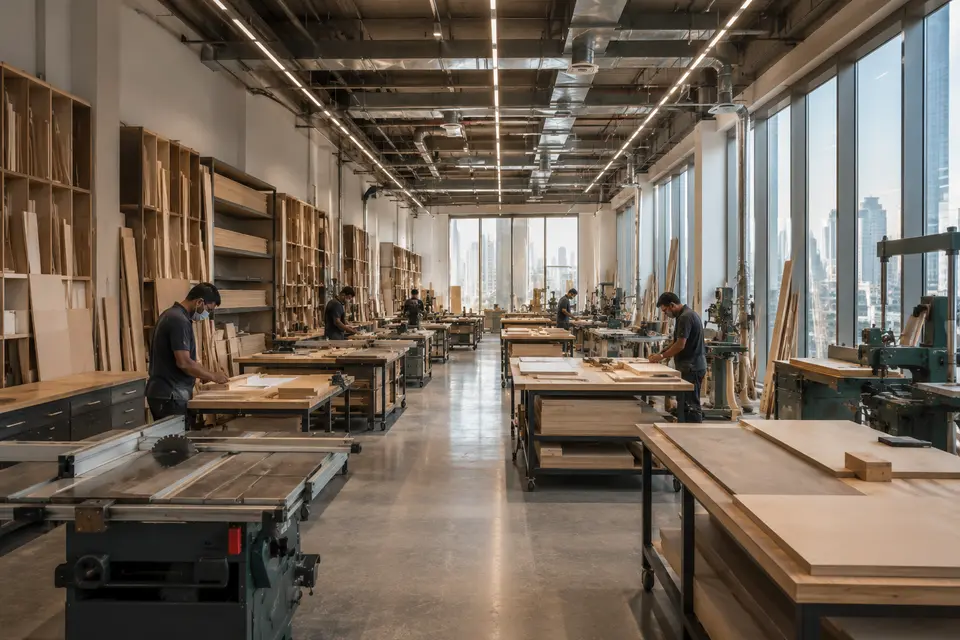
Every custom cabinet, reception desk, and bespoke furniture piece that arrives at a Dubai home or office begins its life somewhere else entirely — inside a carpentry workshop where raw timber and panel material are transformed into finished products. A well-equipped carpentry workshop in Dubai brings together skilled craftsmen, precision machinery, and careful material sourcing to produce joinery that meets the exacting standards Dubai clients expect. Acrylic Gallery Display Products LLC operates a dedicated carpentry workshop that handles everything from single custom furniture pieces to large-scale office and retail fit-out projects. Understanding what actually happens inside a professional workshop helps clients see why workshop-made carpentry outperforms furniture assembled on-site from pre-cut components.
Material Selection and Preparation
Quality carpentry starts long before the first cut is made. Every workshop project begins with material selection — choosing the right wood species, panel product, or veneer for the specific piece being built. Solid hardwoods are checked for moisture content, grain consistency, and surface defects before they leave the storage area. Engineered panels such as MDF and plywood are inspected for flatness and edge condition, since a warped panel creates problems throughout the entire build. Materials are then cut to rough size and allowed to acclimatize to workshop conditions, particularly important in the UAE where humidity and temperature differ significantly between storage, workshop, and final installation environments.
Precision Cutting and Machining
Modern carpentry workshops rely on a combination of manual skill and precision machinery to achieve consistent results. Panel saws cut sheet material to exact dimensions with clean, splinter-free edges. CNC routing machines cut complex shapes, joinery profiles, and decorative details with a level of accuracy that hand tools cannot match. Edge banding machines apply matching edge trims to cut panels, giving a finished appearance to exposed edges. And specialist joinery machines cut dovetails, mortise and tenon joints, and other traditional joinery details that give furniture its strength and longevity. This combination of technology and craftsmanship is what separates workshop-built carpentry from generic furniture.
Assembly and Quality Craftsmanship
Once individual components are cut and machined, skilled carpenters assemble each piece by hand. This is where craftsmanship becomes most visible — checking that joints fit tightly, that drawer runners glide smoothly, that doors hang square, and that every surface aligns correctly before any adhesive or fixing is applied. Dry-fitting components before final assembly catches problems early, when they are still easy to correct. Clamping and curing times are respected rather than rushed, since forcing an assembly before adhesive has properly cured weakens the joint permanently. This stage of the process is where a carpentry workshop earns its reputation, one properly finished joint at a time.
Finishing and Surface Treatment
The finishing stage protects the wood and gives the piece its final appearance. Sanding progresses through increasingly fine grits to remove machining marks and prepare the surface for finish application. Lacquer, veneer, laminate, and paint finishes are each applied using techniques suited to that specific material, since a finish applied incorrectly can peel, bubble, or discolour over time. Spray booths with controlled ventilation ensure an even, dust-free finish on painted and lacquered pieces. Quality control inspection checks colour consistency, surface smoothness, and overall appearance before any piece leaves the workshop for delivery or installation.
Custom Orders and Project Management
A professional carpentry workshop handles far more than standard furniture runs. Custom orders — a specific cabinet size, a matching finish for an existing interior, a reception desk designed around a company logo — require workshop staff to interpret drawings, confirm specifications with the client, and adapt standard processes to non-standard requirements. Project management within the workshop schedules material procurement, machining time, assembly, and finishing to meet client delivery dates, particularly important for commercial fit-out projects with fixed opening dates. Acrylic Gallery Display Products LLC manages every custom order through this same structured process, from initial specification to final delivery.
Related blogs – How Carpenter Services in Dubai Ensure Accurate Measurements and Perfect Fit
Why Workshop-Made Carpentry Matters
Furniture built in a proper workshop consistently outperforms site-assembled alternatives in fit, finish, and durability. Workshop conditions allow for precision that is simply not achievable on a busy construction site — controlled dust levels, stable temperatures for finishing, and access to the full range of machinery needed for accurate joinery. Clients who choose workshop-manufactured carpentry receive furniture and joinery built to last, with the quality control that comes from every stage happening under one roof. Acrylic Gallery Display Products LLC’s carpentry workshop in Dubai continues to deliver this standard of quality across residential, commercial, and hospitality projects throughout the UAE.

Conclusion
A professional carpentry workshop in Dubai is where design concepts become finished, functional furniture and joinery. From material selection through cutting, assembly, and finishing, every stage of the process at Acrylic Gallery Display Products LLC’s workshop is managed to produce results that last. Contact Acrylic Gallery Display Products LLC today to discuss your custom carpentry requirements.